+65 8129 4204
17 Phillip Street, Grand Building
#04-00
Singapore, 048695
Mon: 10am – 5pm
Tue: CLOSED
Wed: 10am – 5pm
Thu: CLOSED
Fri: 10am – 5pm
Sat: 9am – 1pm
Sun: CLOSED
While historical misconceptions once labeled chiropractic as unscientific, modern Neuromusculoskeletal Medicine (NMSM) is firmly rooted in neuroscience and evidence-based practice.
We have moved beyond the simplistic, old-fashioned idea of “putting bones back in place.” Instead, current research demonstrates that our treatments work by providing specific sensory inputs to your nervous system, helping to “re-map” how your brain controls your body and dampening the “central sensitization” that causes chronic pain.
I practice according to rigorous clinical guidelines—just like your medical doctor—utilizing advanced diagnostics to treat the functional “software” problems of the nervous system that standard imaging often misses.
Furthermore, the “quackery” label is a relic of the past; today, chiropractic specialists are integrated into major hospital systems, Veterans Administration facilities, and Federally Qualified Health Centers because our approach is proven to be safe, cost-effective, and scientifically valid.
I do not operate outside of medicine but collaborate directly with medical doctors and surgeons.
My goal is to provide a “third option” for care—based on anatomy, physiology, and pathology—when medication has failed and surgery is not yet necessary.

Absolutely. While my Neuromusculoskeletal Medicine (NMSM) board certification (DIANM) is an international credential, the human body and the mechanisms of pain are universal.
This advanced, post-doctoral training represents the “Gold Standard” in non-surgical spine and joint care, going far beyond the basic requirements for licensure in either country. In the United States, specialists with this training are integrated into major hospital systems and Veterans Administration facilities because of their ability to diagnose complex conditions that standard providers often miss.
I bring this rigorous “medical detective” approach to Singapore to solve a problem many local patients face: the “diagnostic dilemma” where you have pain, but your MRI is labeled “normal” or “unremarkable.” My training equips me to look past simple structural damage and identify the functional and neurological causes of your pain.
Furthermore, this certification trains me to speak the language of your other medical providers. I write detailed medical reports and actively co-manage cases with Singaporean GPs and specialists, ensuring that you receive a world-class standard of care that bridges the gap between standard chiropractic and mainstream medicine.
Absolutely. I view my role not as an alternative to standard medical care, but as a vital partner within your healthcare team.
As a Neuromusculoskeletal Medicine (NMSM) specialist, I function as an “Expert-Generalist,” bridging the gap between your General Practitioner and surgical specialists. My first priority is rigorous diagnostic triage to rule out “red flags” of serious disease such as infection, fracture, or tumor. If your examination reveals a condition that requires medication, injections, or surgery, I will refer you to the appropriate provider immediately. I recognize my professional limitations and believe that patient safety and appropriate care always supersede business interests.
When we proceed with treatment, it is my standard practice to co-manage your case with your other healthcare providers to ensure you receive the “whole package” of care. I actively communicate with your GP through detailed medical reports that explain the specific physiological source of your pain and our treatment progress.
My goal is to serve as a problem-solver for your medical team—offering a “third option” when surgery isn’t necessary but standard care hasn’t provided relief—ensuring everyone is working together for your recovery.
As an elite Neuromusculoskeletal Medicine (NMSM) specialist, my primary role extends far beyond providing treatment; I am, first and foremost, a diagnostician. I recognize that recovering from a complex injury requires holistic support, which includes achieving diagnostic certainty for both your peace of mind and your insurance providers.
Standard medical care often struggles to arrive at a firm diagnosis for complex spinal and neurological pain, frequently dismissing it as simple “muscle spasms” or generic mechanical pain.
Unfortunately, this lack of clarity can cause insurance companies to minimize the severity of your injury or deny necessary coverage.
To combat this and advocate for your recovery, I now offer comprehensive, specialist-level medical reports for your insurance claims (SGD$50/letter).
These are not standard, automatically generated doctor’s notes. They are meticulously crafted clinical documents designed to educate the reader and establish undeniable medical necessity.
Definitive Diagnosis: Translating complex “software” (neurological) and “hardware” (structural) dysfunctions into established, valid medical criteria that insurance adjusters and medical counterparts recognize and respect.
Objective Clinical Evidence: Correlating advanced imaging (like MRIs) with precise orthopedic and neurological testing to validate your specific tissue injuries.
A Clear Prognosis: Outlining exactly why your pain is not simply “self-resolving” and justifying the specific timeline and necessity of your treatment plan to achieve long-term functional recovery.
By requesting a formal diagnostic report, you ensure that the true complexity of your condition is scientifically validated, making your claim for support clear, justified, and irrefutable.
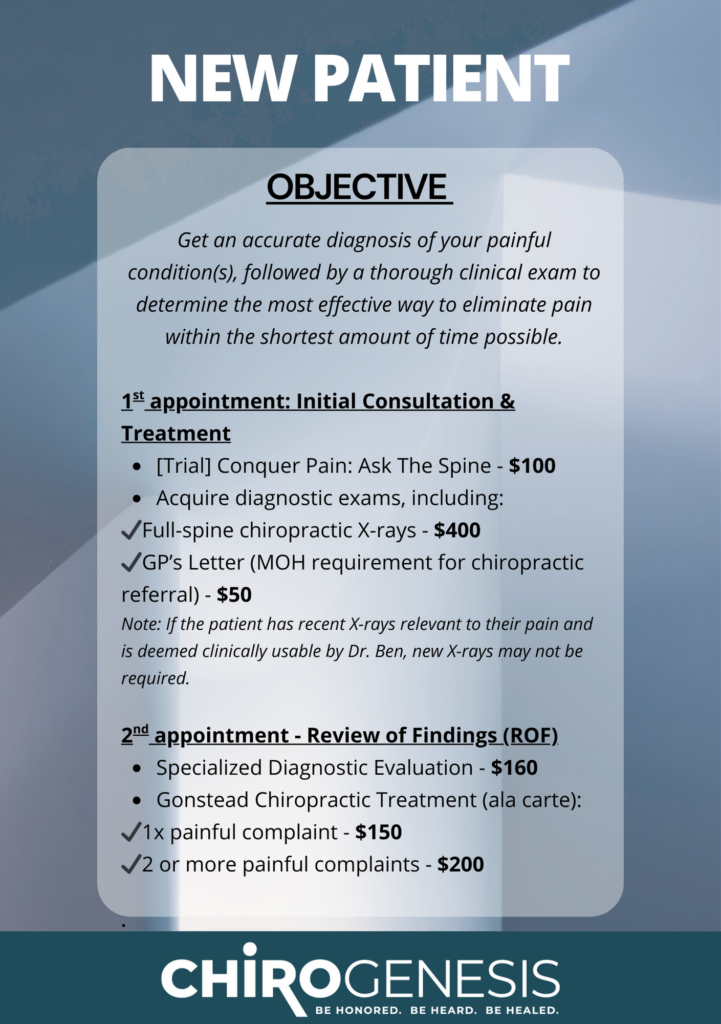
The clinical use of X-rays within a Chiropractic office has been a hot topic of debate. In Dr. Ben’s office, standard full-spine X-rays are taken for almost all patients at registered radiology clinic, Quantum Medical Imaging, here in Singapore.
Here is what sets apart Dr. Ben’s use of X-rays compared to the Chiropractic industry standard. Traditional X-ray analysis focuses on alignment – which is “old science”, and not backed by modern and pain neuroscience.
Most patients expect X-rays to show a “broken part” or a “bone out of place.” However, research shows that many structural findings on X-rays—such as disc degeneration or arthritis—are common even in people without pain. If we treat only what we see on the film, we often miss the true cause of your suffering.
For structural (or biomechanical) approach to assessing relevant joints, Dr Ben uses the time-tested Gonstead system of full-spine and extremity treatment and management. For every joint in question, when substantiated by relevant X-rays, a sound Chiropractic adjustment can be derived by thorough Gonstead line-drawing analysis.
It is worthy of mention that the above use of X-rays cannot be a standalone diagnostic and treatment tool.
My approach acknowledges that the spine is a “sense organ” for the brain. I use imaging to identify specific joint levels where “proprioceptive” (position sense) signals are corrupted. By targeting these specific functional lesions, we provide the brain with the high-quality sensory input it needs to down-regulate pain and restore muscle control.
Have a look at some case studies that Dr Ben commonly sees in everyday practice.
Chirogenesis17 Phillip St, #04-00 Grand Building, 17, Singapore
5.0 51 reviews